Showing posts with label Twin Peaks. Show all posts

August 27, 2007

Questions in a World of Lynch


If you are like me and are a die hard Twin Peaks fanatic then David Lynch's latest interview with MTV (in which he discusses Inland Empire, cooking, The Bourne Ultimatum and digital video) gives us hope that one day - ONE DAY! - we may finally get to see all those long lost deleted scenes from the Twin Peaks movie prequel Fire Walk With Me. The infamous scenes are handpicked by Lynch his apparent five-hour version of Fire Walk With Me that featured story strands from many many more characters that featured throughout the television series, but were deleted from the film because they didn't relate to the Laura Palmer storyline. The reclusive scenes have been tied up in a bitter legal debate between MK2 Films in Europe and New Line Cinema, who released the film. There were rumoured the scenes would show up on some Europe edition of the film, but nothing has come from it.

But, as I said, Lynch (notorious for being stingy on DVD goodies) has given us hope.

MTV: Are you planning to go back to any of your earlier work and add bells and whistles to the DVDs?

Lynch: The only one that's been talked about is "Fire Walk With Me." There are many short scenes that weren't in the final film that on their own are interesting. They just never fit in the film. There's talk of me editing and mixing those. There's a scene with Jack Nance. It's a short scene with Ed [Wright], who played Mr. Mibbler. I loved this guy. He was in "Wild at Heart" as well. Both of them are gone, so to fix those scenes, for the memory of them, it's real important.

It would be great if us Peak tragics could finally get the final piece of the Twin Peaks puzzle. The last footage (that is known to exist) never seen by anyone. There are several pictures on the internet from these scenes and there are online petitions and even MySpace page.


Now that I think of it, there is one more thing we Peaks fans would like, and that would be the release of Angelo Badalamenti's second series score. The first soundtrack is the highest selling television soundtrack of all time, but it was released for the first season and there are many beautiful pieces of music that were used in the second series that are currently only available in random places. The MySpace page I linked to above includes a piece of music entitled "Shelley Quits" and it's magic.

July 15, 2007

Cate's Not Here

Holy crap! I have no idea what is going on in this scene from (genius/mad scientist/brilliant) Todd Haynes' new Bob Dylan "biopic" I'm Not There, but it's mesmerising and I'm reminded of that episode of The Simpsons where Homer watches Twin Peaks and says "Brilliant! ...I have absolutely no idea what's going on."

June 24, 2007

Bringing the Synthesised Score into the 21st Century


This is my entry into the Film Music Blog-a-Thon over at Windmills of My Mind. Enjoy.


Fact, Angelo Badalamenti's "The Voice of Love" is my favourite piece of film music ever. It's from the score to one of director David Lynch's very best (yet, very underrated) films - Twin Peaks: Fire Walk With Me and it is featured in the very last scene of the movie as Laura Palmer, realising her fate, sits in The Red Room. I've included the clip below. Don't worry if you haven't seen the movie (or, more importantly, the television series) as there aren't any spoilers other than - shock - Laura is dead, but if you didn't already know that then I assume you a) don't know the first thing about Twin Peaks and b) you don't care. So no matter what you position in the Twin Peaks universe is (Masterly Scholar or Peak Virgin) watch the clip below and enjoy some beautiful music. If you are new to the Peaks universe then surely this clip will entice you.

Just for the record, this scene probably takes the top spot on my non-existent theoretical Best Ending Scenes of All Time list. It's so beautiful and moving and haunting and Sheryl Lee is amazing.


Now, the 1980s were a very exciting time for those two love, cherish and worship synthesised music scores. The two most famous composers of this variety of film score were Vangelis (Chariots of Fire - you know that music - and Blade Runner - simply amazing) and Angelo Badalamenti who has an incredibly tight relationship with David Lynch ever since he worked on the music to Lynch's 1986 masterpiece Blue Velvet.

Below is a scene of that movie featuring the song "Mysteries of Love". Music by Badalamenti, vocals by another Lynch frequenteur Julee Cruise.


I could write an entire essay on the music to the television series Twin Peaks (y'all know that opening theme music), but this is a film music entry, so I'll skip.

As the synthesised score died, it seemed only Lynch and Badalamenti continue to utilise it in film. Jumping forward to 15 years after Blue Velvet and nine after Fire Walk With Me, Badalamenti produced one of the finest film music scores ever, again for a David Lynch film - Mulholland Drive.

In a day and age where synthesisers can sound incredibly dated (they will never grow old for me), it seems like a risk to make one as the major hooks of your film. And it is just that, a hook. Film scores these days rarely have such a defining place in a movie. Sure, they're important and sometimes they can be amazing and sometimes they're not, but it's not common to find a film is actually better for having it's score in place (think of the likes of Psycho or Jaws or any other film that has one of those clear and definable themes).

Badalamenti's Mulholland Drive music doesn't have one singular piece of music that defines the rest of the score, but the culmination of Badalamenti's work on the film raises the film. Can you imagine this movie with any other music? I would think not. Can you imagine being set with such atmospheric unease as "Mulholland Drive"? Or that ending as being so romantically tragic without "Love Theme"? Or would the Silencio sequence be less enigmatic and scary without Badalamenti's bass-filled terror enducing "Silencio"? Would Betty's (Naomi Watts) arrival to LAX be as good without the hopeful beauty of "Mr Roque - Betty's Theme"? I truly doubt it. Badalamenti's score is such an intricate key to developing the dreamlike mysterious world of Lynch's Los Angeles.

Below are two clips from Mulholland Drive. One is the afore-mentioned Club Silencio sequence, which is a masterpiece in it's own right of the mix of visuals and audio. Then we have a fan-made clip using "Diane and Camilla" put over the top of various scenes from the movie.


I hope that Badalamenti continues to work with Lynch and that their partnership brings around many more equally amazing music. And here's hoping that the synthesised score makes a return! I've mentioned before about how happy I am that electronic music is being used again for film scores (The Fountain and Danny Boyle's Sunshine) so we're just one step away! Obviously, it's not to say that synthesisers are the only tricks up Badalamenti's sleeve. He routinely uses other more traditional forms of scoring in Lynch films as well as outside of the Lynch world. But, it's just a fact that when discussing Lynch and Badalamenti the mind instantly jumps to this sort of sub-section of music.

PS; How shocking was it that Badalamenti still has no Oscar nominations to his name. He's one of the most note worthy film composers out there. Even his work in the '80s, when synthesised scores were all the rage, he didn't have any luck. That crazy music branch will surely be making it up to him someday.

April 30, 2007

Must-Have Monday

New Feature!


Every Monday I will post two songs for you guys to download and listen to in their awesome glory. Some will be obscure, some not so obscure. Some will be old, some not so old. Some will be originals, some will be covers. I didn't intend to start off this feature with two cover songs, but I've been listening to them like crazy this last week so I thought I'd do them. Plus, one is (sort of) Madonna and the other is (sort of) Twin Peaks. Naturally, this feature will be patchy, in that I won't always do it. It's just for whenever I can bothered, I guess.

You may not love all the songs I post, but you should give them all a try if they sound even remotely interesting. I have good taste in music you guys. I'm a music critic for crying out loud! *looks around suspiciously …what? I am!

If you're a stickler for album art in iTunes then click the below images to see their proper size and then save them.

Ciccone Youth - "Into the Groove(y)"
Download Here

An offshoot of Sonic Youth, in the late '80s Ciccone Youth showed up with The Whitey Album featuring predominantly (all?) covers of famous songs. The most famous is probably "Addicted to Love", but my favourite is their cover of Madonna's 1985 hit "Into the Groove". It's what I like to call trash rock (guitar music that isn't at all refined) and it even features, quite illegally I might add, some of Madonna's original "Into the Groove" singing. It's amazing.

One-Eyed Jacks - "Falling [Log Lady Remix]"
Download Here

One-Eyed Jacks, from what I can gather from the few-and-far-between, bits and pieces about them on the ‘net, were some random band who, in 1991, decided to release an EP of remixes of the iconic track “Falling” by Julee Cruise. If you’re a fan of Twin Peaks then you will certainly know the song. There was a “Ronnette Polaski” remix and two versions of the “Log Lady Remix”. I could have just as easily posted the original Cruise version and everyone would be right as rain, but I thought I’d twist it up and post this version as it is also ace.

Anyone know what happened to these guys?

Thanks to SendSpace for hosting the files. If anyone out there is linked to these artists and wishes for me to take these files down and by all means shoot me an email and I'll take it down.

April 23, 2007

Business as usual

Sorry about the lack of updates over the weekend, but I was swamped. As I mentioned in the comments to the Hilary Swank entry below I was busy during Friday day and at night I had a friend's 21st dinner which went late. Then me and Hannah stayed up all night watching Twin Peaks until the killer of Laura Palmer was finally revealed to her. I know I had already seen the second season (about 5 years ago), but due to the much better quality of the DVDs and my general forgetfulness it was like watching it through new eyes. Although there were several bits that made me chuckle/sad because I knew what was actually going on (such as the mysterious Chinese businessman). We were majorly tired at 8am so we didn't watch any more. We didn't get see see Joan Chen dissolve into a puddle, David Duchovny in drag or any number of doppelgangers that seem to appear throughout the rest of the series. Anyway. Then I was busy most of Saturday and Sunday I had work from 6.30 in the morning which makes me grumpy.

So, hopefully it's back to business as usual. It's nice to know that most of you guys kept coming back to check the place out. That's awesome.

So, I remember in an entry I made some time recently somebody (sorry, I don't remember who or what thread) asked if I could write some comments on two movies I saw recently - Vince Ward's River Queen and Harvey Weinstein's George Hickenlooper's Factory Girl.

It's kind of amusing that this person chose these two films because they're both very similar.

River Queen is a film by Vincent Ward that had a very notorious filming shoot. Vincent Ward was kicked off the film at some point a replaced by his cinematographer Alun Bollinger (and a great cinematographer he is). Ward was then reinstated during the post-production stage. There were also reports of Samantha Morton's diva antics and everyone getting ridiculously sick amongst and the film was apparently ripped to shreds. It shows. Especially in the first and third acts. There really does appear to have been a lot just simply cut right out. The end is particularly bizarre as the film suddenly just cuts to several years into the future and then ends.

The second act is actually quite well done. There's some very interesting stuff there and I just wish the rest of the film was up to snuff. The cinematography is just wonderful - Bollinger knows just was moss-covered rocks or vine-covered rockfaces to film. However, the same can't be said for the music score, which is sort of a disaster. I think it made my ears bleed, a little. The music did get a laugh out of me a few times though because it was so ridiculously over the top. Oh, and Keifer Sutherland is terrible, too. I'm not sure what he was doing there, but it wasn't good. Samantha Morton was fine, as was Cliff Curtis (recently seen in the less-messy-but-still-messy Sunshine). Stephen Rae is barely in it to even bother commenting (a result of the first act being butchered, I presume).

Factory Girl is another mess of a movie, but one I liked more purely because I'm more interested in the topic at hand. It's pretty darn obvious that Harvey Weinstein and the Biopic of Doom were at play here. I have a sense that director George Hickenlooper had a much different version in mind. One that revolved a lot more around the Factory (Andy Warhol's social hangout for artists), but that Harvey Weinstein decided to throw in truly bizarre dialogues between Edie Sedgewick (Sienna Miller) and a therapist and trying to amp up the silly romance subplot between Sedgewick and Bob Dylan, played with dead-in-the-water excitement by Hayden Christensen. Did he even want to be there to make this movie? He hardly seems to care.

Thankfully the music and costume design is all pretty good, even if it is more "retro chic" that actual period accurate. Sienna Miller is actually very good as Sedgewick, and she gets some big moments towards the end to make up more than enough Oscar-clips (Hi Harvey, again!) and I really liked Guy Pearce as Warhol. Still, it's only a movie for those who are interested in the era of Warhol. And even then it's hardly a detailed and accurate account (I assume).

River Queen, C+, Factory Girl, B-

April 17, 2007

Best. Day. Ever.

Okay, so, yesterday was pretty much the best day ever, alright. Pretty much because of two things. I will discuss each of them.

Reason #1
The Best Amazon Package Ever


Yesterday, I finally got my Amazon purchases and, omg, so good. I got the second and final season of my favourite show of all time Twin Peaks, which I have been waiting for for something like four years. I've already seen it, but that was only on dodgy VHS so I can't wait to watch it again. It was clearly one of the most polarising seasons of a television series ever. Some loved it, some despised it with the burning fire of a thousand suns. I watched the first 15 minutes or so of the season opener and it's already the most bizarre thing you're ever likely to see on TV. So great.

I also received the new "Music Edition" (that's a new one) for my favourite movie of all time, All That Jazz. It's so good. I love it. It has a new feature that skips directly to the musical sequences to save all that time and effort of fast forward through the extra bits. This movie just draws me in so much. I watch one bit and I need to watch another and another and then I need to watch the entire 10 minute finale and then I wanna watch it all over again.

I also received the special edition of Cabaret, which was uber cheap. I think the only version available in Australia is a feature-free edition so this was a worthy upgrade.

Reason #2
Jamie Bell


Jamie Bell. I love him so. Like, majorly. But y'all know that. Yesterday I read the news that Jamie is going to be taking over from Daniel Radcliffe in the West End play Equus. Yes. Jamie will be getting buck wild on stage... IN ENGLAND! Ugh. Nevertheless, my Jamie is gonna be in Equus and I'm super happy for him. It'll give him publicity everywhere, which he apparently needs because according to the Daily Mail article about it he had faded into obscurity (yeah, if you don't pay attention to indie movies and Green Day videoclips and freakin' KING KONG). Whatevs.

Hopefully we'll get some nice advertising material along the lines of what Daniel Radcliffe got. I always figured Jamie would be the kind of guy to go balls out on camera though anyway. I think it's because he's British? They seem to do that more over there than in America

If you want to follow LuLu and Ja's suggestion of a fundraiser to get me over there to go see Equus then feel free to give me your money. That'd totally be the greatest present ever.

Did I tell you guys that I replied to Jamie's golden girl porn MySpace message? I told him I think I should be embarassed that he seemingly discovered my shrine. And he replied... *sigh*... he replied:

nuttin to be embarassed bout mate
it alright. good to be thought of ya know! i didnt photoshop the golden girls pic i found it on the net.
so keep in touch and keep blogging

cheers

He... likes... to... be... though... of... BY ME!!! Holy shit, right?!

God, he tortures me so (and if he's reading this then I HOPE HE'S HAPPY!!)

I say all that with the utmost cheekiness.

April 4, 2007

Sorry

Nothing for you today. I have work and I'm very sick (but I need the $$$ so no sick days for me) so I'm not going to have the energy. But, to celebrate the DVD release today of not only my favourite television series of all time (the second season of Twin Peaks is finally released) but also my favourite movie of all time (All That Jazz comes out in a brand new special edition) I give you two YouTube clips.

The first is one of the single scariest moments ever, and it's from the Twin Peaks pilot. I remember seeing this for the first time on grainy VHS over five years ago (after seeing Mulholland Drive I went on a David Lynch spree) and it terrified me. Trust David Lynch to make even a traffic light ominous. But, the truly scary bit is... well. I'm not really sure what it is. But it sends shivers up my spine. Grace Zabriskie's screams are just so... loud. Don't whatever you do go to the clip's page and click on ANY of the other clips down the side though. They will ruin the mystery of Who Killed Laura Palmer.

The second clip is a song from All That Jazz. It's the big final number with Roy Scheider and Bob Vereen. Don't watch it if you don't want the ending spoiled. I guess you won't even know what's going on for most of it though.


How crazy is it that Twin Peaks and All That Jazz are released on the same day? I had pre-ordered them off Amazon so they should be arriving in a week or so. EEP!

January 4, 2007

Holy Smokes!


April 10
$36.99(US)
6 Disc Set

!!!!!!!


The Australian release in November last year came and went without anything eventuating and now the Australian websites (like ezyDVD) say "Release Date Unknown". But I got an e-mail today from Amazon showing me the one thing I need to complete my life is going to finally be released.

Now, take note that its a) not a special edition, b) there doesn't appear to be any special features at all at this stage and c) it's only six discs, which means the quality will be lower than on Season 1. Season 1 had four discs for SEVEN EPISODES. Season 2 is a proper full-length season and it's six discs, so... yeah.

But, I'm just so excited. OMG! It's already #1 on Amazon's best seller list and it's only in pre-orders!

Now, there doesn't appear to be any word on the rumoured Complete Series box-set, which was to be released in Australia along with the second season late last year. That was to include the entire series (two seasons) and special features for the first season that weren't available when that was released a few years back.

This will totally be the sort of release that they'll do twice. I can just tell. Thing is? I'd probably buy it 20 times just so I could have everything.

OMGOMGOMGOMGOMGOMGOMGOMGOMGOMG

December 6, 2006

In honour of Angels in America

TOP 5 ANGEL APPEARANCES
1. The Angel of America (Emma Thompson), Angels in America
2. The Angel in the Red Room (Lorna MacMillan), Twin Peaks Fire Walk With Me
3. The Angel of Death (Jessica Lange), All That Jazz
4. Angel (David Boreanaz), Buffy the Vampire Slayer (Welcome to the Hellmouth)
5. Angel Dumott Schunard (Wilson Jermaine Heredia), Rent

November 22, 2006

An Essay About Mulholland Drive

So, I had to write an essay for my Myths & Symbolism class at class. It had to be on a certain text (literature, film, whatever). I originally chose Twin Peaks, but that proved too difficult and wide ranging (and cause I don't own the second season, that made it even harder) so instead I chose Mulholland Drive. I thought I'd post it on here. Have a read if you so wish. I'm not gonna go through and re-italicise all the titles and such, but there is one paragraph that is a big spoiler to the "Who Killed Laura Palmer" mystery of Twin Peaks (Lynch, ever the wiley one, totally made connections between the two if you didn't already know). So I italicised that one if you don't know and wanna know until the second season is released (sigh, WHEN?) So, yeah, enjoy. Oh, I haven't really proof read it so it's quite rambly in places, but whatever. I get a bit that way when discussing Lynch. And I continued to find it difficult to describe the whole Betty -> Diane, Rita -> Camilla thing because one of the specifics of the assignment was to assume the reader (the teacher) was knowledgable with the text, but I felt I still had to keep mentioning it. At some times I call her Betty/Diane, other times I call them Betty and then at othertimes Diane. Same with Rita/Camilla. Aah, so confusing, but not really if you're like me and you know what you're on about.


Assessment Task 3 – Analysing Mulholland Drive
David’s Lynch’s Mulholland Drive is a movie that he wrote and directed as a television pilot, before turning it into a feature film. Lynch’s work, which includes television, film, art and multimedia, regularly involves heavy usage of symbolism. Mulholland Drive is a prime example of this. The film’s use of symbolism has left the film with a typically Lynchian feel of unknown. There doesn’t seem to be one theory for the film that ties everything together, but instead there are hundreds of individual interpretations on the film. Lynch’s desire to never speak of the true meaning of the symbolism in Mulholland Drive only goes to intrigue viewers even more.

Two characters we meet early in the film are an old couple that travelled with the leader character of Betty from Deep River Ontario to Los Angeles. One theory involving these characters is that they represent “erinyes”. These figured are present in Greek mythology and act as pursuers of criminals. Mythology tells us that these erinyes (pronounced “I-rin’ee-eez”, which sounds like “Irene”, the name of the old lady) pursue wrongdoers relentlessly until they are driven mad and commit suicide. This theory fits into Mulholland Drive as the final scene of the movie features the old couple returning and for seemingly no reason tormenting Betty (who at that point has become the character Diane in a role-reversal) until she grabs a gun and kills herself.

Similarly, the old couple could also represent the innocence of Betty/Diane’s past in Deep River, before she came to Los Angeles. They represent wholesome values (they are first seen awarding Betty a first prize at a jitterbug competition, yet another sign of Lynch’s fetish for twisting 1950s into modern day evil) and their return at the climax of the film symbolises Diane’s grief over a criminal act. She feels her past coming back and knowing she can’t turn back, which leads to her committing suicide.

The character of the monster behind the Winkie’s restaurant (actually just a homeless person) is another one steeped in possible symbolism. His arrival in the film comes just as one man dies. The homeless man could represent many things, but I think it is one of two. The man acts as a physical embodiment of Betty/Diane’s guilt over the criminal act I discussed earlier (the criminal act being the hiring of an assassin to murder her former lover Camilla). The guilt that Diane feels is so great that it can kill an innocent man who merely looks at him.

At the same time it represents the failure on her part to become the “movie star” or “actress” that she came to Los Angeles to be. David Lynch uses the film to act as an essay on the way Hollywood treats (and mistreats) women such as Betty/Diane. The homeless figure, in such close approximation to one of the highlights on LA – Sunset Boulevard, just exemplifies this. Acting as a sort of second representation of Betty/Diane herself, it shows that no matter how close to fame and fortune she would get, she was doomed from the start. That the homeless man is a harbinger of death it seems (every time he appears a character dies), just further proves that Betty/Diane was doomed from the start. Where she goes, death follows.

A scene involving a man and his psychiatrist takes place at the Winkie’s restaurant before the homeless man kills the patient mysteriously. This patient is seen later in the film in the segment where Betty has become her real persona, Diane. He is merely a man in the restaurant at the time that Diane meets with the hired killer. This proves that the homeless man that appears behind Winkie’s is the manifestation of Diane’s guilt. The man says to his psychiatrist that it can see through walls. I take this as meaning that Diane’s guilt is so large and overpowering that it holds no boundaries. That the homeless man kills the patient merely by looking him is another clue that the guilt Diane feels is so powerful that it can kill a single person for no reason, other than he was there at the time that the guilt was formed.

David Lynch’s casting proves to be symbolism in itself. In Mulholland Drive actresses who have appeared on television soap operas play four of the female characters. Laura Elena Harring (Camilla/Rita) appeared on General Hospital and Sunset Beach while Naomi Watts (Betty/Diane), Melissa George (Camilla) and Elizabeth Lackey (Carol) all appeared on Home & Away. The themes of mistreatment of actresses seems to be the prime reason behind this decision, as his two lead actresses (Watts and Harring) had never proven to be thespians of the highest quality.

Lynch’s casting of these soap opera stars is particularly sneaky because that is a genre of programming that is routinely mocked and made fun of (Lynch’s love of the field could be seen clearly in his own television series “Twin Peaks”). Another trademark of Lynch is the casting of musicians (in Mulholland Drive’s case it’s Billy Ray Cyrus and Rebekah Del Rio), another group of people who are routinely mocked when it comes to acting. Lynch uses these groups to symbolise how Hollywood routinely dumps them when they are no longer useful (aka, no longer beautiful or selling records). They represent anybody who has ever been in a similar position. That the film shows the trials of a woman who came to Hollywood with big dreams, but then got them effectively stomped on, is ripe.

The red lamp is a key feature in the film, appearing at several moments throughout the film. The red light could represent prostitution, a theory that is two-fold. It could symbolise Diane’s descent into being a prostitute of the Hollywood system. Getting cast as an extra in a movie that her ex-lover Camilla has the lead in, or just generally doing whatever she can to survive in the industry. It could also be a very literal clue as to where the character of Diane is in life. Having struck out in the movie business she would very well have become a prostitute. A possible key to this theory is the character of Mr Roque, a mysterious man who could symbolise her boss (pimp, if you will). Diane routinely receives phone calls from men connected to Mr Roque. A red lamp appears in another scene involving a hit man and a prostitute, another clue lending credence to this theory.

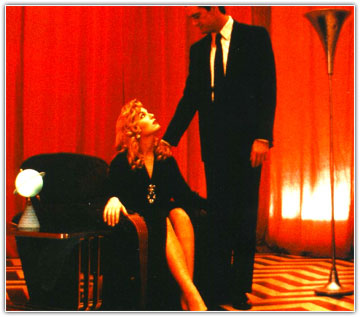
The club that Betty and Rita attend is Club Silencio, a strange place that bares a lot of resemblance to the Red Room from Twin Peaks. With it's red drapes, the “music in the air” and the loss of reality – in the red room characters can float, at Silencio they can vanish. I believe Club Silencio acts as a coping mechanism for the real Diane as she starts to wake up from her dream-filled sleep. I believe it acts as a way of telling Betty (Diane’s imagined self) that not all is as it seems and that what she’s experiencing isn’t actually real, but is indeed a dream. Characters speak, play instruments and sing, yet we are merely listening to a pre-recorded tape and actors are playing out the roles.

Among the characters we see at the club (all of which appear elsewhere in the film as manifestations of Diane’s subconscious), Rebekah Del Rio is a singer who performs Roy Orbison’s “Crying” in Spanish. Her performance appears so real that Betty and Rita start crying, yet even though we have already been told is it all “a recording” they forget this, further proving that Betty thinks what she is experiencing is real. Del Rio soon collapses and the music keeps playing, pointing to Diane that not everything she is seeing and hearing can be trusted. It is at this moment that Betty notices the blue box in her bag.

The blue box is one aspect of Mulholland Drive that causes much debate. Continuing on the theory that Betty doesn’t really exist and is an idealised figment of Diane’s imagination, it would be logical to say that the blue box symbolises a sort of Pandora’s Box. Just as Rita/Camilla is about to open the box with the blue key she possessed at the start, Betty disappears. Again, continuing on the theory that the entire film is Diane’s dream, this makes perfect sense. The appearance of the box along with the blue key, which we later discover was the calling card left by the Diane’s hired killer, makes Diane, still dreaming, start to realise what she has exactly done. You could say that all the puzzle pieces have come together.

When Rita turns the key the camera literally zooms inside and from then on it’s as if we’ve entered the real world of Diane, possibly as she comes further out of her dream world and closer to consciousness. The theory that the box is a Pandora’s Box holds up because once it is opened Diane starts to recognise the enormity of the situation and from then one we start to see the real story of Diane and Camilla – or, as real as Diane’s dream will allow us to see. In one scene, the old couple (the perceived erinyes) are seen, in miniatures, crawling out from the blue box as it drops to the ground from the hands of the homeless man. This doppelganger of symbolism suggests that, in my interpretation, the homeless man is indeed the manifestation of her guilt and that the Erinyes are emerging from Pandora’s Box to torment Diane.

One character that appears at Club Silencio is the near-unnoticed blue-haired lady. It is not until the very final moments of the film that you realise she was in the club scene, sitting up in her balcony spot observing the proceedings. I believe her presence is the key to unlocking the secrets of the film. The last frames of the film are of the blue-haired lady drowned in blue light whispering the word “Silencio” and nothing else. I think this tells us the Club Silencio scene is the moment we should focus our attention on. It would symbolise that everything, and that’s including the second half of the scene which is apparently the “real” story, isn’t to be believed. It is indeed one big dream of Diane and you can never believe everything that occurs in the dream. For all we know Diane could have been a much worse person than she sees herself.

The blue-haired lady could also be Lynch’s ethereal representation of God. A mysterious and omnipresent creature that stays above everybody and everything, possibly manipulating or guiding the people below, but ultimately proving to be a powerless entity. If that is the case, then the pseudo-magician to takes centre stage at Club Silencio could represent the devil. The magician appears to have powers of manipulation that he is actively using on Betty and Rita. Just as the blue-haired lady is seen to sit above the audience, the magician stands on the stage below the audience, working his magic on the crowd. This symbolism could further represent Diane’s descent into Hell, luring Betty/Diane down to him as God, the blue-haired lady, sits aloof above them. It is not God’s responsibility for the likes of Diane to not sin, but it is the Devil’s business to lure her to his side.

One of the major theories that holds much water is that the character of Diane suffered from abuse as a child. There are many symbolised clues to attest to this theory. At the end of the film as the old couple are chasing Diane through her house there is a quite audible moment when the viewer can here the simultaneous cry of a little girl and an older man. The audition scene involves Betty auditioning for a role as a character who has an affair with “Dad’s best friend”. In Twin Peaks Laura Palmer’s murderer (and sexual abuser) was Bob, or “Dad’s best friend”. But “Bob” was actually the identity that Laura saw in her mind, when it was really her father molesting her.

Other clues include when Betty says she comes from Deep River Ontario. In David Lynch’s 1986 film Blue Velvet that character played by Isabella Rossellini lives in the Deep River Apartment block where she is routinely sexually and physically abused. The character of Rita in Mulholland Drive takes her name (when she can’t remember her real one) from a Gilda poster. Gilda starred Rita Hayworth who was known to have been sexually abused as a child by her father. And most significantly, I think, is when Diane and Camilla are on the couch in her apartment, Diane gets sexually violent and it is said that abuse victims are more likely to become abusers than those who weren’t. Lastly, the film within the film is called The Sylvia North Story seemingly set in the 1960s. In 1965 a film was released called Sylvia about a character called Sylvia West who was raped by her stepfather and then later became a prostitute. This also puts weight behind the theory of Diane becoming a prostitute in life after her acting dreams failed.

There are many more examples of symbolism throughout Lynch’s masterpiece, but the beauty of it is that you never can quite tell what are symbols are what are merely Lynch playing games with his audience. There is very solid evidence that supports the theories that people have come up with since the film’s release in 2001. It isn’t hard to believe thought that Lynch put everything in for a reason and that the symbolism works on multiple levels so people can get different meanings. Lynch’s use of symbolism is a trademark that he continuously uses throughout his work and it is all part of the tapestry of one of his pieces.

{fin}

November 20, 2006

Underrated Movie of the Week


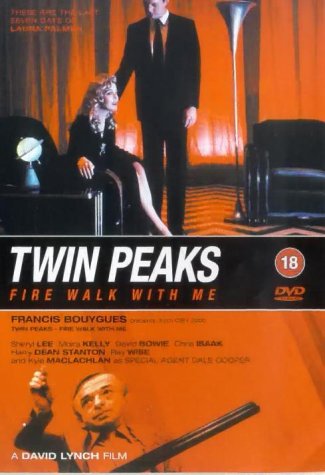
Twin Peaks: Fire Walk with Me, 1992, dir. David Lynch, starring Sheryl Lee, Ray Wise, Moira Kelly, Madchen Amick, Dana Ashbrook, Phoebe Augustine, Eric DaRe, Miguel Ferrer, David Lynch, Chris Isaak, Keifer Sutherland, Peggy Lipton, James Marshall & David Bowie